





CATALOGIC
Predicting microbial biodegradation (BOD, CO2 Production), metabolic pathways and stable biodegradation products
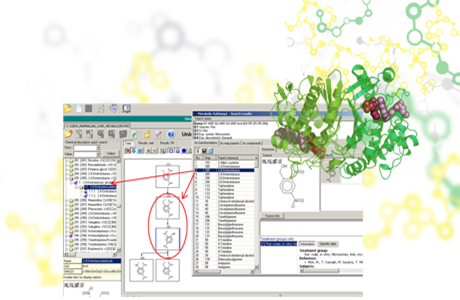
Biodegradation: CATALOGIC is a principally new platform for models targeting environmental fate of chemicals. It affords possibility to develop models for simulation of catabolism and metabolism accounting for logic of enzyme controlled molecular transformations. The approach reflects the grouping of genes in operons in microorganisms or formation of enzyme complexes in higher level organisms. This enzyme organization resulted in a channeling effect which initiates a sequence of predefined molecular transformations used for utilization of a specific chemical - the product of one reaction is transferred to the next active site and prevents the release of unstable intermediates in cell compartment. Based on collected empiric catabolic information several layers of hierarchy are used to control the application of molecular transformations. Each molecular transformation is characterized by its inherent probability of occurrence. These probabilities are used to determine the so called apparent probabilities of occurrence depending on the number and type of simultaneously applied transformations. Inherent probabilities are estimated by making use of a non-linear least squares method on the basis of ready biodegradability tests data such as biochemical oxygen demand (BOD), CO2 production, ultimate half-lives, quantities of metabolites, etc. For user convenience, the platform was designed to supports also the pioneer models CATABOL (not accounting for the metabolic logic, kinetic component, multiendpoint information, etc.). Currently, the following models are implemented in CATALOGIC platform:
CATALOGIC models
- 28 days MITI (OECD 301C) model – simulates multipathway biodegradation and predicts BOD, half-lives (primary and ultimate), and quantities of metabolites within the MITI I (OECD 301C) test conditions
- Abiotic 28 days MITI (OECD 301C) model – simulates abiotic degradation and predicts quantities of transformation products within the MITI I (OECD 301C) test conditions
- BOD kinetic (OECD 301F) model – simulates multipathway biodegradation and predicts biodegradation within 10 days window, half-lives (primary and ultimate), and BOD and quantities of metabolites as a function of time within the OECD 301F test conditions.
- Soil BioPath model - simulates multipathway biodegradation in soil
CATABOL models
- MITI (OECD 301C) model - simulates single the most probable pathway of biodegradation and predicts BOD and quantities of metabolites within the MITI I (OECD 301C) test conditions
- Ready Sturm (OECD 301B) model - simulates single the most probable pathway of biodegradation and predicts CO2 production and quantities of metabolites within the OECD 301B test conditions
Besides biodegradability endpoints the platform performs prioritization of the potentially persistent degradants according to their quantity, physicochemical properties and acute toxicity.
Bioaccumulation: Base-line model for estimating BCF (OECD 305) is included in CATALOGIC. The base-line concept for modeling the bioconcentration of chemicals is based on a reference curve delineating the empirically observed maximum bioconcentration driven by hydrophobicity of chemicals. In fact, this is the highest log BCF (log BCFmax) which can be reached for a given log Kow value assuming that the molecules (small sized, not ionized) exhibit maximal bioavailability and are not metabolized. Mitigating phenomena and chemical properties that can reduce bioconcentration potential, such as molecular size and flexibility, ionisation, biotransformation, etc., are used as reducing factors of the maximum bioconcentration determined via the base-line. The metabolism simulator is using the machinery developed in LMC, utilizing a heuristic algorithm to generate plausible metabolic maps using the set of principal transformations. Given the shortage of fish metabolism data rat liver data was used as an appropriate surrogate. Molecular size (flexibility) and ionization were used as the most significant factors defining the bioavailability of chemicals. Instead of the empiric pass/no pass threshold used in previous studies to assess the effect of molecular size on bioaccumulation a smooth function describing the probability of a chemical to cross the cell membrane with increase of its size is used. The effect of conformational flexibility is accounted for explicitly. The analysis of the relative importance of the three mitigating factors showed that the passive diffusion has 70% contribution, metabolism - 25%, whereas the rest of all mitigating factors was 5%.